These Mason Jar Instant Noodles are the perfect work lunch. The jars are packed full of veggies, vermicelli noodles and shredded chicken!
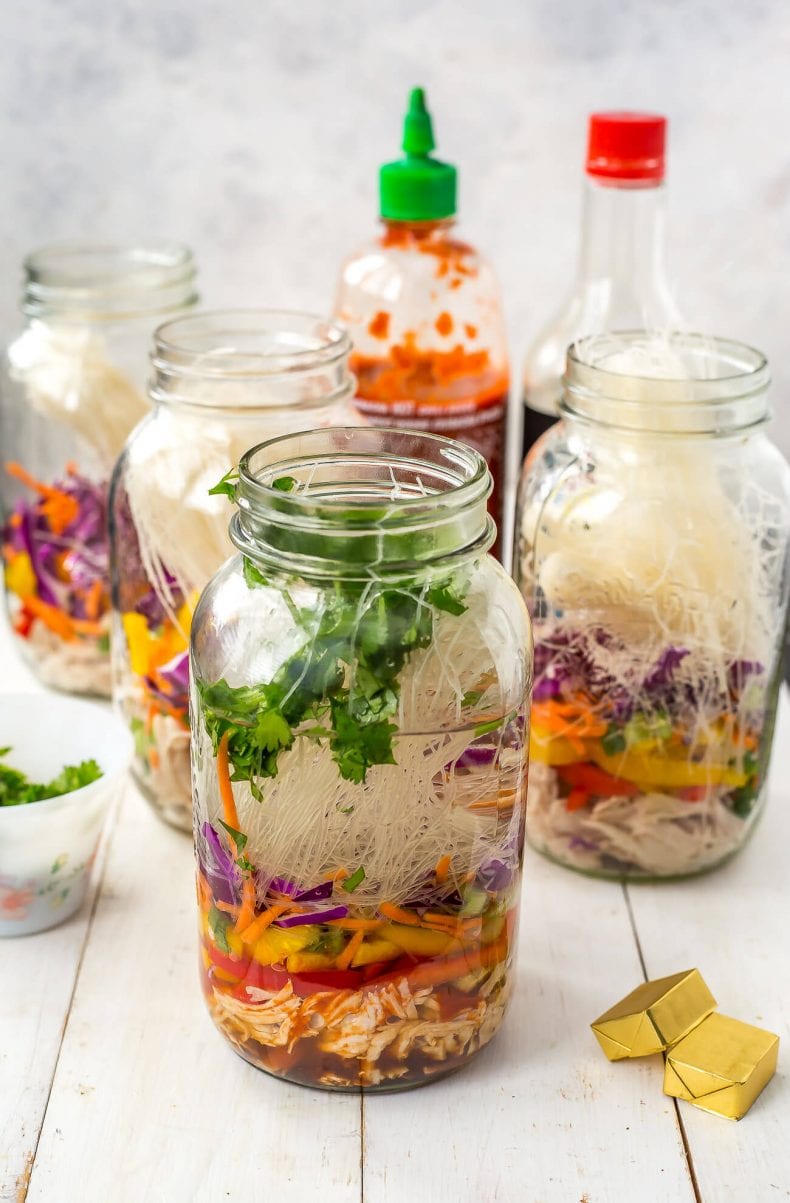
This recipe went viral for a reason! It’s one of my favourite recipes I’ve ever shared and one I always recommend if you want a fast, healthy lunch that doesn’t feel boring. Not to mention how Instagram-worthy it is!
Why you’ll love this recipe
- Meal prep friendly: Prep these mason jar instant noodles ahead of time, then just add boiling water when you’re ready to eat.
- Healthy & customizable: Packed with protein and veggies and easy to switch up with your favourite add-ins so you’re never bored.

Ingredients and substitutions
- Chicken breasts – Swap for chicken thighs or another protein of choice.
- Soy sauce – Coconut aminos or tamari are great substitutes.
- Sriracha chili garlic hot sauce – Leave out if you don’t like heat, or swap for lemon pepper, Italian seasoning, or Old Bay.
- Lime juice – Fresh or bottled lime or lemon juice can be used.
- Vegetable bouillon cubes – Chicken bouillon cubes would also work.
- Julienned veggies – Use any mix you like. Other great options include beans, chickpeas, lentils, spinach, kale, zucchini, cabbage, or cooked mushrooms.
- Rice vermicelli noodles – These are great because they are thin and cook fast! Zucchini noodles could also work.
- Sunflower sprouts – Swap for cilantro or bean sprouts, or leave off entirely.
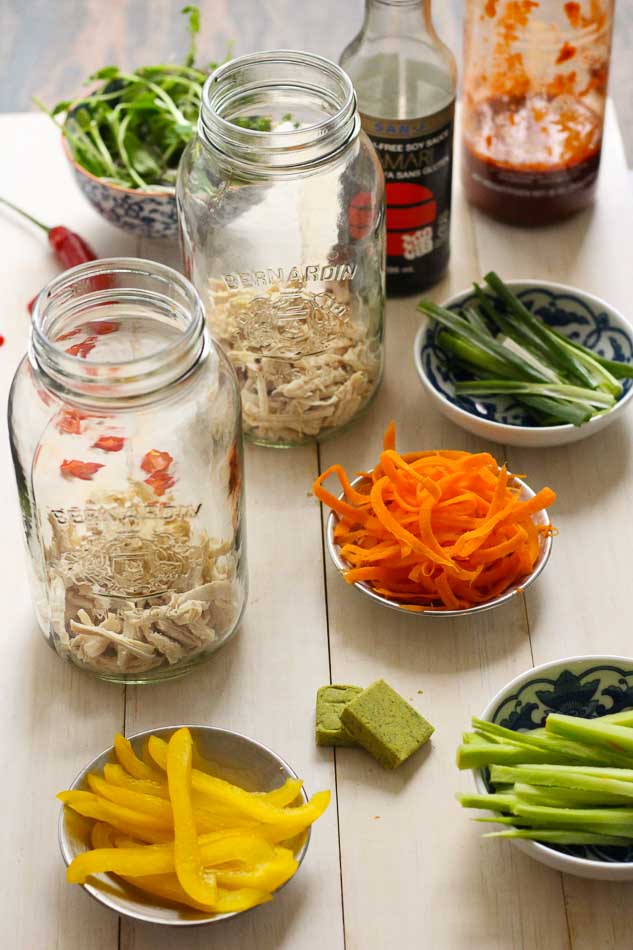
How to make mason jar noodles
Step 1: Cook the chicken.
Cook the chicken then shed it.
Step 2: Prep the veggies.
Slice, chop and shred any veggies you are using.
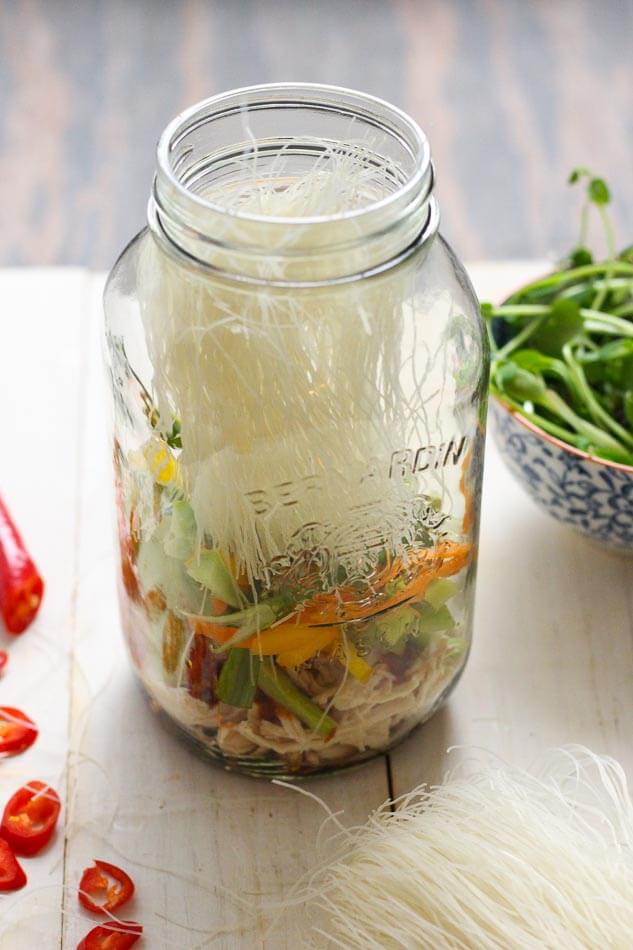
Step 3: Layer ingredients in the jars.
Gather ingredients and jars and start layering. Follow these layering rules!
Step 4: Store for later.
Store the prepped jars in the fridge until you’re ready to eat.
Mason jar soup variations
There are lots of different ways you can customize these mason jar noodles to your liking. Try out different combos until you find something you love!
- Protein: Chicken thighs, chicken breast, rotisserie chicken, tofu, shrimp, beef, edamame, beans, chickpeas, lentils
- Veggies: Spinach, kale, zucchini, cabbage, mushrooms, bell peppers, bok choy
- Noodles: Rice vermicelli, zucchini noodles, miso noodles, cellophane noodles, ramen
- Seasoning & Sauces: Sriracha, sweet chili sauce, lemon pepper, Italian seasoning, Old Bay, hoisin sauce
- Toppings: Hard-boiled egg, green onions, bean sprouts, cilantro
Frequently asked questions
What order do you layer the jars in?
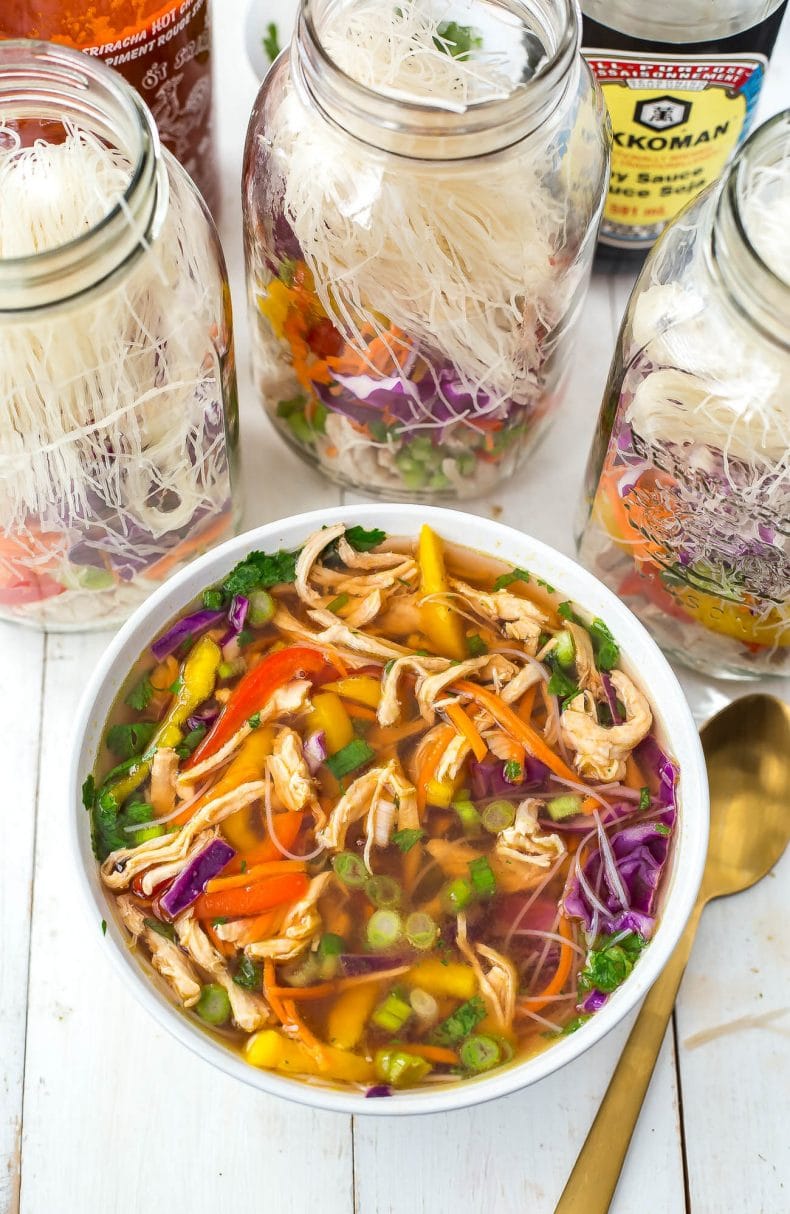
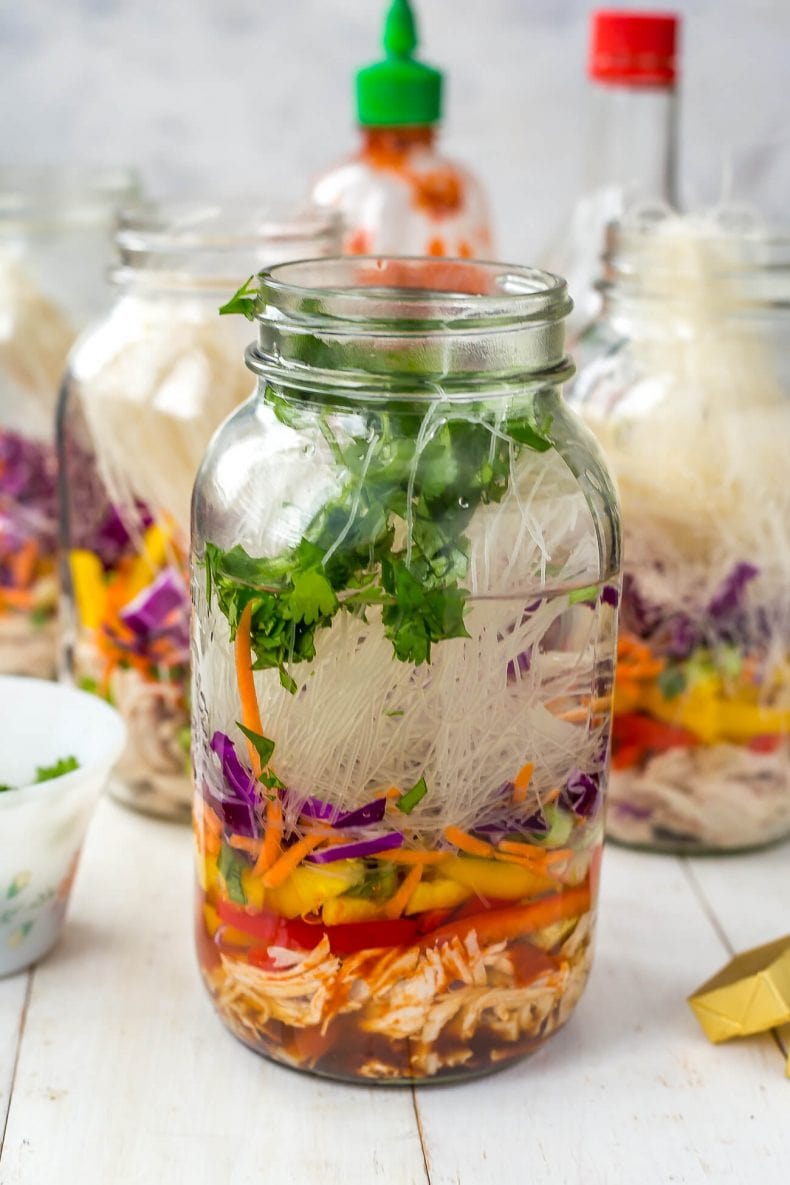
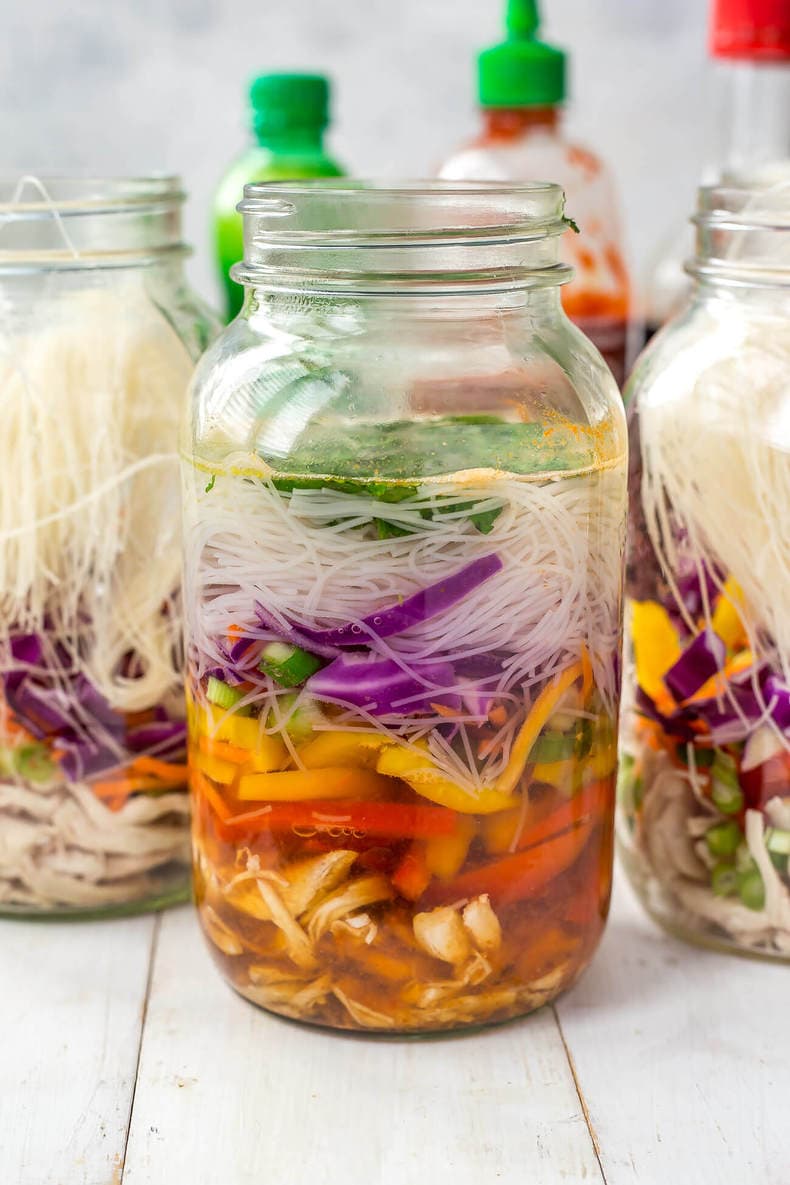
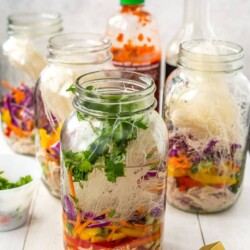
When layering your mason jar soup, start with the shredded chicken, followed by the sauces (soy sauce, sriracha, lime juice), then the vegetables, bouillon cubes, and finally the noodles on top.
How do you serve mason jar soup and how much water do you add?
When you’re ready to eat, pour boiling water into the jar until it’s about 3/4 of the way full (do not fill to the top!). Stir to help the bouillon dissolve and let the noodles cook. If needed, microwave the jar for a couple of minutes. Once everything is hot, pour the soup into a bowl and enjoy.
What jars should you use?
Mason jars work best for this recipe. A 1L or 32 oz jar holds plenty for lunch and keeps liquids at the bottom, away from the noodles. I love glass jars because they are safe, easy to clean, and fit neatly in the fridge.
What can you prep ahead of time?
All the prep can be done in advance. Cook and shred the chicken, chop the veggies, and assemble the jars ahead of time so you have easy, ready-to-go lunches all week.
Storing and reheating
Storing: Store prepped mason jars in the fridge for up to 4–5 days (without the added water). If you don’t finish your soup, you can store leftovers in the fridge, but make sure to enjoy within a day or two for best texture.
Reheating: Reheat in the microwave or on the stovetop until heated through.
Freezing: For best results, fully prepare the soup (including the boiling water), let it cool, then freeze in a freezer-safe container or Souper Cubes for up to 3 months.
Defrosting and reheating: Reheat straight from frozen in the microwave for 6–7 minutes, stirring halfway through, until heated through.

Mason Jar Instant Noodles
Equipment
Ingredients
- 2 chicken breasts cooked and shredded
- 4 tsp soy sauce or tamari
- 4 tsp Sriracha chili garlic hot sauce
- 4 tsp lime juice
- 4 vegetable bouillon cubes
- 1/2 cup each julienned broccoli stems, carrots, bell peppers and green onions
- 1 lb package rice vermicelli noodles
- Sunflower sprouts or cilantro for garnish
Instructions
- To shred chicken, boil breasts in a large pot of hot water for 12-15 minutes until chicken is cooked through. Pull apart with your hands or with a fork once cooled.
- Divide the shredded chicken into each mason jar evenly, then add 1 tsp of soy sauce, Sriracha and lime juice to each jar.
- Layer in vegetables, then drop in bouillon cubes. Finally, finish by dividing vermicelli noodles evenly among each jar and keep in fridge until ready to eat.
- When ready to serve, pour boiling water in to fill jar and carefully stir contents, making sure to dissolve bouillon cube completely and saturate noodles. You may also need to microwave the jar for 1-2 minutes depending on the type of noodles used (some varieties of vermicelli are harder than others). Let the jar sit for 5 minutes before serving.
- Pour contents of the jar into large bowl when ready to eat (should be within 5 minutes of pouring boiling water) and eat right away!
Video


Comments & Reviews
peter francis says
That’s the link I currently have open in my chrome tabs and was the recipe i mentioned.
TBH, I only just saw the ‘3 ½ tbsp salt’ on the ingredients list…ouch!
There must be alternatives to the salt (repeatedly bangs head on table), even alternatives to healthier salt! 🙁
So after a quick google, I found this…
“Saltneys salt alternative is a 100% salt alternative that is made with completely natural ingredients, is virtually sodium free, high in natural potassium and has all the flavour of regular table salt and sea salt.
Saltneys Salt Alternative | 99.5% less sodium that regular salt”
A possible alternative. It’s approx £4 ish on amazon for 100g so not super cheap. Suppose it depends on how many stock cubes you can make 🙂
Generally a good rating apart from a couple of people who say it doesn’t taste great (similar comments you expect to find for sugar alternatives too).
’19 natural salt alternatives’ search turned up some interesting results too!
And Taylor, you have been of super help and I thank you.
Think I’ve pestered you enough tonight :-/
Really like the website BTW
peter francis says
Thankyou Taylor.
I thought it might just be a case of compiling specific herbs, spices etc. Isn’t it just meat stock that takes hours? (excuse my naivety in this department lol)
I have found recipes for ‘Homemade Instant Bouillon Cubes’ for example as i thought that would be the best place to start as Bouillon Cubes are mentioned a lot in these DIY instant noodle recipes.
I’m not particularly looking for vegan homemade stock or anything, just something that is tasty and healthy for the noodles. I obviously need to experiment somewhat. Just want to avoid off the shelf stock cubes if possible
Taylor Stinson says
That would be so cool to try! I wish I could help more on this end but I’ve never tried making the homemade bouillon/stock cubes before. May be something for me to experiment with myself and hopefully provide a recipe in the future. Doing a quick Google search myself it looks like you can blend up a bunch of different veggies (carrots, celery, onion, garlic, leeks, parsley, etc) but then there is still a ton of salt that needs adding. See this recipe here, over 3 tbsp among 16 cubes it looks like: http://paleogrubs.com/homemade-instant-bouillon-cubes. I think no matter how you slice it there’s going to be a ton of sodium in one BUT at least you can maybe make them less processed. Here’s another recipe that uses actual homemade stock: http://www.simplebites.net/homemade-bouillon-cubes/. I initially suggested the store-bought bouillon cubes to save time since this is a meal prep recipe and most people just don’t have the time to do a project like this, but it could be worth investigating/experimenting on my own because if something can be batch made like this, it may be a better way to enjoy a meal prep soup 🙂 Thanks for the feedback Peter and sorry I couldn’t be of more immediate help!
peter francis says
Taylor, have you tried any experiments in making the broth/flavour base/paste etc from scratch without using say something like bouillon cubes etc so that way, one could make the entire DIY instant noodles without anything premade whatsoever.
If so, i’d be interested in your findings, take care
Taylor Stinson says
Hi Peter! Unfortunately no I have not tried this – I know it’s ideal to have everything in a recipe made from scratch but without making a liquid stock by hand (which would take hours in the kitchen), I don’t see how you could make a similar equivalent. At least it’s not something I specialize in – sorry about this!
S Janus says
Well – I must be doing something wrong. Those rice vermicelli noodles do not cook in 2-3 minutes. Or even 5 minutes. Most packages suggest you soak them for 10 or more minutes. Others have you boil them and let them sit. I have tried using them for these Mason Jar Instant Soups and the results is not eatable. Putting them in uncooked and then trying it after 5 minutes leads to crunch in noodles that should be cooked. Waiting longer – everything starts to taste mealy and starchy. Yuck. Can you tell me how to get the noodles to actually cook correctly?
Taylor Stinson says
Hmm, I’m not sure what you could be doing wrong here! Maybe we aren’t buying the same vermicelli noodles. The ones I buy are super thin and cook very quickly. Are you pouring the boiling water directly over the noodles and then saturating them in the water? Sometimes I zap the jar in the microwave after pouring the boiling water if I have a lot of veggies in the jars. I’m going to update the recipe with this note. I make this recipe on a regular basis for lunch and have never had a problem so I’m sorry it didn’t turn out well for you! 🙁
Sandy K says
You’re using bean thread vermicelli noodles, not the regular rice ones. I think the ones she’s talking about above take way longer to cook and boil on the stove for a number of minutes. She could soak them though.
bubbles. says
Yeah if you look at the vermicelli noodles she supposedly buys, the instructions say to presoak them for 10-15 minutes before cooking them in boiling water. If you don’t presoak you have to boil them for 10-12 minutes. So it’s doubtful she’s cooking them for 3 (count em) minutes. Regular instant ramen has to cook longer than that.
Taylor Stinson says
Perhaps this article could illuminate you: https://www.finecooking.com/ingredient/rice-vermicelli-noodles
“Rice vermicelli only need to be soaked in hot water, instead of boiled, before they’re ready to use in stir-fries or other dishes. Bring a medium pot of water to a boil, remove the pot from the heat, and add the noodles. Let the noodles soak until they’re tender, about 5 minutes. Drain and pat dry.”
EricaM says
These look fabulous and I’ve been making a similar meal at home, but need a take to work version. Thx! If I may suggest, try using miso paste instead bullion cubes. I agree with LaRee on bullion cubes. If you can, find an unpasteurized miso paste , it’s full of probiotics for healthy gut flora and has much better flavour. Any good whole food store will carry in the refrigerated section. I highly recommend Traditional Miso which is locally made in southern Ontario. Just make sure the water isn’t boiling when you add it to your mason jar. My suggestion is to boil the kettle and then wait a minute or so for the temperature to drop below boiling and then add the water to the mason jar. Boiling water will kill the good bacteria in the miso. I’d suggest a heaping tablespoon to start and then adjust to your own taste. Your jars are 1L which is what I’m basing it on. Enjoy!
Matt L. says
Just made some of these with my office mates today. Great idea! Cheers!
Taylor Stinson says
Yay! So glad to hear that Matt 🙂
LaRee says
Since i don’t like using bullion cubes due to their high salt content (even low sodium ones) and additives, I’ll just bring along another jar with homemade chicken broth, veg., or beef broth. A little extra work but works fine for me. The vermicelli noodles made with green bean starch or sweet potato starch also sound interesting. Thanks
Sandy Byron says
Hi Taylor, quick question about the recipe–it calls for 1 chicken breast then the instructions tell you to layer in half a chicken breast. Does the recipe only use half a chicken breast or is the other half supposed to be added somewhere in the layers/process? Thanks for clarifying!
Taylor Stinson says
Hey Sandy! I have updated the recipe to clarify that it’s 2 mason jars. You cook and shred the chicken, then divide the chicken between the two jars. Hope this helps! 🙂
angela says
Hi Taylor – I understand that you divide the chicken between 2 jars, but do you add half the amount of soy, sriacha and bouillion to each jar as well – 1 tsp soy and sriacha, 1/2 tsp lime to each jar? Or do you add the recipe’s measurements to each jar?
Thanks
Taylor Stinson says
Hi Angela! It’s 1 tsp soy and sriracha then 1/2 tsp lime juice in each jar – I have updated and clarified this in the recipe 🙂
J says
When you pour boiling water into the mason jar, doesn’t it crack? Do you recommend any other jars that won’t crack with the temperature change?
Taylor Stinson says
No it definitely doesn’t! People use mason jars in canning and pickling all the time which involves boiling the jars to seal them. I have also made this recipe several times without issue as well. Mason jars are by far the safest thing you can use!
Beccy says
What is the capacity of the mason jars please?
Taylor Stinson says
The mason jars I use hold up to 1L! I will update this in the recipe!